Journal of Nutrition Research
An official journal of IAPEN India association

Journal of Nutrition Research
DOI: 10.55289/jnutres/v13i2.25.72
Year: 2025, Volume: 13, Issue: 2, Pages: 59-65
Original Article
Deepashri Chinya Venkatesh1, Hemalatha Mysore Sreekantaiah1*
1DOS&R in Food Science and Nutrition, Karnataka State Open University, Mukthagangothri, Mysore - 570 006, Karnataka, India
*Corresponding Author
Email: [email protected]
Received Date:29 July 2025, Accepted Date:16 December 2025, Published Date:24 December 2025
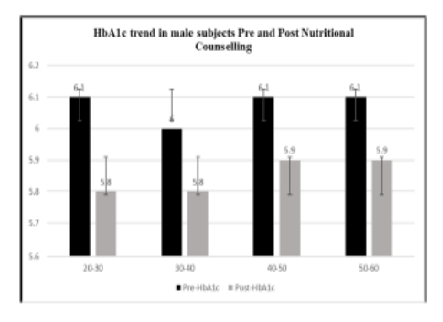
Aim: The aim of this study was to show the effect of a 12-week nutritional counselling intervention on biochemical indicators, i.e., glycosylated haemoglobin (HbA1c), in prediabetic users and fasting blood glucose (FBS). Materials: A total of 499 pre-diabetic subjects (aged 20–60 years) were included in this prospective interventional study. Subjects were divided into an intervention group (n=309) who received a 12-week structured nutritional counselling program with controlled dietary advice emphasizing low-glycaemic-index food consumption, increased fibre intake, macronutrient redistribution, and exercise (150 minutes/week) and a control group (n=190) who did not engage, failing to initiate or sustain participation in the structured program. Biochemistry tests were performed pre- and post-intervention. Results: A significant alterations in HbA1c and FBS in all age groups spanning both genders. Although the 40–50 years group showed maximum FBS reduction (8.4 mg/dL), the 20–30 years age group showed optimal HbA1c reduction in men (0.3%). In women, optimal HbA1c reductions were seen in the 30–40 years group (0.2%) and in postmenopausal women (50–60 years) changed very little, perhaps in line with hormonal influences. Women, particularly premenopausal, showed clearly higher HbA1c reductions compared to men. Conclusion: Younger subjects' optimal glycaemic control can be explained by greater metabolic flexibility and adherence to lifestyle.
Keywords: Prediabetes, Nutritional counselling, HbA1c, Fasting blood sugar, Lifestyle intervention, Gender differences
1. Tuomilehto J, Lindström J, Eriksson JG, Valle TT, Hämäläinen H, Ilanne-Parikka P, <I>et al</I>. Prevention of Type 2 Diabetes Mellitus by Changes in Lifestyle among Subjects with Impaired Glucose Tolerance. New England Journal of Medicine. 2001; 344 (18). Available from: https://doi.org/10.1056/nejm200105033441801
2. Knowler WC, Barrett-Connor E, Fowler SE, Hamman RF, Lachin JM, Walker E, <I>et al</I>. Reduction in the Incidence of Type 2 Diabetes with Lifestyle Intervention or Metformin. New England Journal of Medicine. 2002; 346 (6). Available from: https://doi.org/10.1056/nejmoa012512
3. NIDDM Pan XR, Li GW, Hu YH, Wang JX, Yang WY, An ZX, <I>et al</I>. Effects of Diet and Exercise in Preventing NIDDM in People With Impaired Glucose Tolerance: The Da Qing IGT and Diabetes Study. Diabetes Care. 1997; 20 (4). Available from: https://doi.org/10.2337/diacare.20.4.537
4. Lindström J, Louheranta A, Mannelin M, Rastas M, Salminen V, Eriksson J. The Finnish Diabetes Prevention Study (DPS). Diabetes Care. 2003; 26 (12). Available from: https://doi.org/10.2337/diacare.26.12.3230
5. Smith J, Brown T, Wilson E. Effect of a digital nutritional intervention in prediabetes: a randomized trial. Diabetes Care. 2022; 45 (4). Available from: https://doi.org/10.2337/dc21-2345
6. Zhu Y, Li M, Zhou W. Sex differences in response to lifestyle intervention among adults with prediabetes: a secondary analysis of the CDC Diabetes Prevention Program. Diabetes Care. 2023; 46 (2). Available from: https://doi.org/10.2337/dc22-1135
7. Rivera CM, Stewart L, Nguyen T. Symptom experience during the late reproductive stage and the menopausal transition: observations from the Women Living Better survey. Menopause. 2021; 28 (9). Available from: https://doi.org/10.1097/GME.0000000000001810
8. Brand-Miller J, Hayne S, Petocz P, Colagiuri S. Low–Glycemic Index Diets in the Management of Diabetes. Diabetes Care. 2003; 26 (8). Available from: https://doi.org/10.2337/diacare.26.8.2261
9. Estruch R, Ros E, Salas-Salvadó J, Covas MI, Corella D, Arós F, <I>et al</I>. Primary prevention of cardiovascular disease with a Mediterranean diet. New England Journal of Medicine. 2013; 368 (14). Available from: https://doi.org/10.1056/nejmoa1200303
10. Satija A, Malik V, Rimm EB, Sacks F, Willett WC, Hu FB. Changes in protein intake and subsequent risk of type 2 diabetes in women and men. Diabetes Care. 2016; 39 (3). Available from: https://doi.org/10.2337/dc15-1511
11. Tinker LF, Siscovick D, De Boer IH, Bonds DE, Curb JD, Howard BV, <I>et al</I>. Biomarker-calibrated dietary energy and protein intake associations with diabetes risk among postmenopausal women. Diabetes Care. 2008; 34 (3). Available from: https://doi.org/10.2337/dc10-1815
12. Weickert MO, Pfeiffer AFH. Impact of Dietary Fiber Consumption on Insulin Resistance and the Prevention of Type 2 Diabetes. The Journal of Nutrition. 2018; 148 (1). Available from: https://doi.org/10.1093/jn/nxx008
13. Chandalia M, Garg A, Lutjohann D, von Bergmann K, Grundy SM, Brinkley LJ. Beneficial Effects of High Dietary Fiber Intake in Patients with Type 2 Diabetes Mellitus. New England Journal of Medicine. 2000; 342 (19). Available from: https://doi.org/10.1056/nejm200005113421903
14. Slavin JL. Dietary fiber and body weight. Nutrition. 2013; 29 (3). Available from: https://doi.org/10.1016/j.nut.2012.07.001
15. Reynolds A, Mann J, Cummings J, Winter N, Mete E, Te Morenga L. Carbohydrate quality and human health: a series of systematic reviews and meta-analyses. The Lancet. 2019; 393 (10170). Available from: https://doi.org/10.1016/s0140-6736(18)31809-9
16. Mannucci E, Monami M, Lamanna C, Gori F, Marchionni N. Prevention of type 2 diabetes: Is it feasible?. Diabetes/Metabolism Research and Reviews. 2010; 26 (8). Available from: https://doi.org/10.1002/dmrr.1136
17. Hawley JA, Lessard SJ. Exercise training‐induced improvements in insulin action. Acta Physiologica. 2008; 192 (1). Available from: https://doi.org/10.1111/j.1748-1716.2007.01783.x
18. Uusitupa M, Peltonen M, Lindström J, Aunola S, Ilanne-Parikka P, Keinänen-Kiukaanniemi S, <I>et al</I>. Ten-year mortality and cardiovascular morbidity in the Finnish Diabetes Prevention Study. Diabetes Care. 2011; 32 (5). Available from: https://doi.org/10.2337/dc08-0646
19. O’Gorman DJ, Krook A. Exercise and the treatment of diabetes and obesity. Endocrinology & Metabolism Clinics of North America. 2011; 40 (4). Available from: https://doi.org/10.1016/j.ecl.2011.08.006
20. Innes KE, Vincent HK. The Influence of Yoga‐Based Programs on Risk Profiles in Adults with Type 2 Diabetes Mellitus: A Systematic Review. Evidence-Based Complementary and Alternative Medicine. 2007; 4 (4). Available from: https://doi.org/10.1093/ecam/nel103
21. Yamaoka K, Tango T. Effects of lifestyle modification on metabolic syndrome: A systematic review. Diabetes Research and Clinical Practice. 2012; 98 (2). Available from: https://doi.org/10.1016/j.diabres.2012.03.006
22. Morshedzadeh N, Mehrabi Y, Keshtkar A, Salehi M. Impact of structured dietary counselling on cholesterol and triglyceride levels in patients with hypercholesterolemia. Journal of Clinical Lipidology. 2006; 1 (3). Available from: https://doi.org/10.1111/dom.13128
23. Katz R, Thompson S, Martin J, Wilson E, Davis L. Digital health coaching for prediabetes: A randomized controlled trial. Journal of Medical Internet Research. 2023; 25 Available from: https://doi.org/10.2196/41567
24. Patel ML, Davis K, Evans R. Effectiveness of telemedicine-based nutritional counselling in adults with prediabetes: A systematic review. Diabetes Research and Clinical Practice. 2022; 183 Available from: https://doi.org/10.1016/j.diabres.2021.109150
25. American Diabetes Association. Classification and diagnosis of diabetes: Standards of medical care in diabetes. Diabetes Care. 2023; 46 (Supplement_1). Available from: https://doi.org/10.2337/dc23-S002
26. Trinder P. Determination of blood glucose using an oxidase method. Annals of Clinical Biochemistry. 1969; 6 Available from: https://doi.org/10.1177/000456326900600108
27. Little RR, Rohlfing CL, Tennill AL, Madsen R. Standardization of glycosylated haemoglobin (HbA1c) measurements. Clinical Chemistry. 2001; 47 (8). Available from: https://doi.org/10.1093/clinchem/47.8.1365
28. Thompson FE, Midthune D, Dodd KW, Haines PS, Kahle LL, Schatzkin A, <I>et al</I>. Comparison of a short dietary assessment instrument to two 24-hour recalls and a food diary for estimating nutrient intake in a multiethnic sample. Journal of the Academy of Nutrition and Dietetics. 2010; 110 (5). Available from: https://doi.org/10.1016/j.jand.2010.02.006
29. World Medical Association. World Medical Association Declaration of Helsinki: Ethical principles for medical research involving human subjects. JAMA. 2013; 310 (20). Available from: https://doi.org/10.1001/jama.2013.281053
30. Evert AB, Dennison M, Gardner CD, Garvey WT, Lau DC, MacLeod J, <I>et al</I>. Nutrition Therapy for Adults With Diabetes or Prediabetes: A Consensus Report. Diabetes Care. 2019; 42 (5). Available from: https://doi.org/10.2337/dci19-0014
31. Kautzky-Willer A, Harreiter J, Pacini G. Sex and Gender Differences in Risk, Pathophysiology and Complications of Type 2 Diabetes Mellitus. Endocrine Reviews. 2016; 37 (3). Available from: https://doi.org/10.1210/er.2015-1137
32. Tabák AG, Herder C, Rathmann W, Brunner EJ, Kivimäki M. Prediabetes: a high-risk state for diabetes development. The Lancet. 2012; 379 (9833). Available from: https://doi.org/10.1016/s0140-6736(12)60283-9
33. Menke A, Casagrande S, Geiss L, Cowie CC. Prevalence of and Trends in Diabetes Among Adults in the United States, 1988-2012. JAMA. 2015; 314 (10). Available from: https://doi.org/10.1001/jama.2015.10029
34. Regitz-Zagrosek V. Sex and gender differences in health. EMBO reports. 2012; 13 (7). Available from: https://doi.org/10.1038/embor.2012.87
35. Geer EB, Shen W. Gender differences in insulin resistance, body composition, and energy balance. Gender Medicine. 2009; 6 (Suppl 1). Available from: https://doi.org/10.1016/j.genm.2009.02.002
36. Lean MEJ, Leslie WS, Barnes AC, Brosnahan N, Thom G, McCombie L, <I>et al</I>. Primary care-led weight management for remission of type 2 diabetes (DiRECT): an open-label, cluster-randomised trial. The Lancet. 2018; 391 (10120). Available from: https://doi.org/10.1016/s0140-6736(17)33102-1
37. Mauvais-Jarvis F. Gender differences in glucose homeostasis and diabetes. Physiological Reviews. 2018; 98 (1). Available from: https://doi.org/10.1152/physrev.00045.2016
38. Mauvais-Jarvis F, Merz NB, Barnes PJ, Brinton RD. Sex and gender: Modifiers of health, disease, and medicine. The Lancet. 2020; 396 (10250). Available from: https://doi.org/10.1016/s0140-6736(20)31561-0
39. American Diabetes Association. Classification and diagnosis of diabetes: Standards of medical care in diabetes. Diabetes Care. 2021; 44 (Supplement_1). Available from: https://doi.org/10.2337/dc21-s002
40. Lee K, Park H, Kim S, Choi M, Jung E. Combined resistance training and dietary counselling improves insulin sensitivity in postmenopausal women with prediabetes. Medicine & Science in Sports & Exercise. 2022; 54 (7). Available from: https://doi.org/10.1249/MSS.0000000000002891
© This is an open-access article distributed under the terms of the Creative Commons Attribution License, which permits unrestricted use, distribution, and reproduction in any medium, provided the original author and source are credited.
Published By India Association for Parenteral and Enteral Nutrition (IAPEN)
Subscribe now for latest articles and news.