• E-ISSN: 2348-1064
  • Follow us

Journal of Nutrition Research
An official journal of IAPEN India association

Article

Journal of Nutrition Research

Year: 2024, Volume: 12, Issue: 2, Pages: 110-122

Original Article

An Exploratory Cum Prospective Study to Assess the Impact of Nutritionally Balanced Enteral Formula Feed in Critical Care Patients

Received Date:23 December 2024, Accepted Date:30 December 2024, Published Date:31 December 2024

Abstract

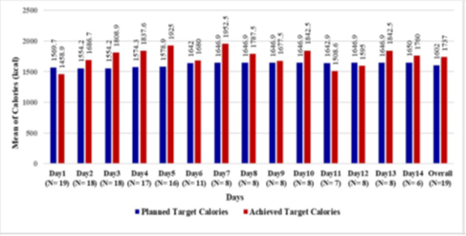
Enteral Nutrition (EN) prevents malnutrition and promotes recovery in critically ill patients. Despite the benefits, current EN formulations are associated with concerns like gastrointestinal intolerance, electrolyte imbalances, and hyperglycemia. Balanced EN formulations improve recovery, reduce hospital stays, and enhance patient outcomes. This study evaluated efficacy and tolerability of a novel balanced EN formula in supporting patient recovery and reducing length of hospital stay in critically ill patients. The study included 19 hospitalized critically ill patients aged ≥18 years, with mean (SD) age of 52.4(14.98) years. EN intake was monitored for a minimum of 3-14 days or until discharge. Target calorie and protein intakes were evaluated in accordance with ASPEN/ESPEN guidelines 2019. The analysis of target macronutrient intake reported adequate levels in 17 (89.5) patients, with a mean (SD) daily caloric intake of 1737 (582.1) kcal, and 95% Class Interval (CI) ranging from 1646 to 1828 kcal. The mean (SD) of daily protein intake was 82.9 (27.78) grams. The mean (SD) hospital stay was 12.7 (9.39) days, with a Interquartile range (IQR) of 11 (7.0;18.0) days and a median of 8 days. Most patients showed improvements in micronutrient profiles and achieved electrolyte homeostasis without hyperglycemic episodes. Notably, no gastrointestinal (GI) complications were observed, and no prokinetic agents were administered, indicating tolerability and acceptance of the formula. No serious adverse events (SAEs) were reported. These findings suggest that the novel EN formula is effective in supporting the recovery of critically ill patients, while demonstrating favourable safety and tolerability profile.


Keywords

Critical Illness, Nutritional Support, Enteral Nutrition, Macronutrients, Micronutrients, Gastrointestinal Tract, Feed Tolerance, Prokinetics, ESPEN Guidelines

References

  1. Eldehily K, Tawfik M, Elkholy M, Sabry S. Impact of Malnutrition in Critically Ill Patients on Intensive Care Unit. The Egyptian Journal of Intensive Care and Emergency Medicine. 2023;3(1):57–69. Available from: https://dx.doi.org/10.21608/jicem.2023.244437.1024
  2. Li Q, Zhang Z, Xie B, Ji X, Lu J, Jiang R, et al. Effectiveness of enteral feeding protocol on clinical outcomes in critically ill patients: a study protocol for before-and-after design. Ann Transl Med. 2017;12(8):e0182393. Available from: https://doi.org/10.1371/journal. pone.0182393
  3. Preiser JC, Arabi YM, Berger MM, Casaer M, McClave S, Montejo-González JC, et al. A guide to enteral nutrition in intensive care units: 10 expert tips for the daily practice. Critical Care. 2021;25(1):424. Available from: https://dx.doi.org/10.1186/s13054-021-03847-4
  4. Kabashneh S, Alkassis S, Shanah L, Ali H. A Complete Guide to Identify and Manage Malnutrition in Hospitalized Patients. Cureus. 2020;12(6):e8486. Available from: https://dx.doi.org/10.7759/cureus.8486
  5. Zaki DSD, Zakaria D. Prevalence of Malnutrition among Hospitalized Medical Intensive Care Unit Patients in a University Hospital. International Journal of Internal Medicine. 2018;7:54–59. Available from: https://doi.org/10.5923/j.ijim.20180704.02
  6. Singer P, Blaser AR, Berger MM. ESPEN guideline on clinical nutrition in the intensive care unit. Clin Nutr. 2019;38(1):48–79. Available from: https://doi.org/10.1016/j.clnu.2018.08.037
  7. Delsoglio M, Pichard C, Singer P. How to choose the best route of feeding during critical illness. Clin Nutr ESPEN. 2020;37:247–254. Available from: https://doi.org/10.1016/j.clnesp.2020.03.019
  8. Boullata JI, Carrera AL, Harvey L, Hudson L, McGinnis C, Wessel JJ, et al. ASPEN Safe Practices for Enteral Nutrition Therapy. JPEN J Parenter Enteral Nutr. 2017;41(1):15–103. Available from: https://doi.org/10.1177/0148607116673053
  9. Jordan EA, Moore SC. Enteral nutrition in critically ill adults: Literature review of protocols. Nursing in critical care. 2020;25(1):24–30. Available from: https://doi.org/10.1111/nicc.12475
  10. Sherif AA, Mansour MA. Enteral Nutrition In Critically Ill Patients. AJAIC. 2006;9(3):56–68. Available from: https://applications.emro.who.int/imemrf/AJAIC/2006_9_3_56.pdf
  11. Schörghuber M, Fruhwald S. Effects of enteral nutrition on gastrointestinal function in patients who are critically ill. Lancet Gastroenterol Hepatol. 2018;3(4):30036. Available from: https://doi.org/10.1016/S2468-1253(18)30036-0
  12. DSS, MV, AG. Advantages of enteral nutrition over parenteral nutrition. Therap Adv Gastroenterol. 2013;6(2):157–167. Available from: https://doi.org/10.1177/1756283X12467564
  13. Zaragoza-García I, Arias-Rivera S, MJFM, Martí JD, Gallart E, José-Arribas AS, et al. Enteral nutrition management in critically ill adult patients and its relationship with intensive care unit-acquired muscle weakness: A national cohort study. PLoS One. 2023;18(6):e0286598. Available from: https://doi.org/10.1371/journal.pone.0286598
  14. Berger MM, Shenkin A, Schweinlin A, Amrein K, Augsburger M, Biesalski HK, et al. ESPEN micronutrient guideline. Clinical Nutrition. 2022;41(6):1357–1424. Available from: https://doi.org/10.1016/j.clnu.2022.02.015
  15. Michel KE. Preventing and managing complications of enteral nutritional support. Clin Tech Small Anim Pract. 2004;19(1):84–91. Available from: https://doi.org/10.1053/S1096-2867(03)00084-7
  16. Lee JW. Fluid and electrolyte disturbances in critically ill patients. Electrolyte Blood Press. 2010;8(2):72–81. Available from: https://doi.org/10.5049/EBP.2010.8.2.72
  17. Gönderen K, Döngel HE, Kol EÖ. Investigation of gastrointestinal complications in patients given enteral nutrition. Clin Sci Nutr. 2022;4(1):1–7. Available from: https://doi.org/10.54614/ClinSciNutr.2022.21515
  18. Brown B, Roehl K, Betz M. Enteral nutrition formula selection: current evidence and implications for practice. Nutr Clin Pract. 2015;30(1):72–85. Available from: https://doi.org/10.1177/0884533614561791
  19. Bodoky G, Kent-Smith L. Basics in clinical nutrition: Complications of enteral nutrition. Journal of Clinical Nutrition and Metabolism. 2009;4(5):e209–e211. Available from: https://clinicalnutritionespen.com/article/S1751-4991(09)00033-X/fulltext
  20. Cabrera G, Sanz-Lorente M, Sanz-Valero J, López-Pintor E. Compliance and Adherence to Enteral Nutrition Treatment in Adults: A Systematic Review. Nutrients. 2019;11(11):2627. Available from: https://doi.org/10.3390/nu11112627
  21. Hsu PH, Lee CH, Kuo LK, Kung YC, Che WJ, Tzeng MS. Higher Energy and Protein Intake from Enteral Nutrition May Reduce Hospital Mortality in Mechanically Ventilated Critically Ill Elderly Patients. International Journal of Gerontology. 2018;12(4):285–289. Available from: https://doi.org/10.1016/j.ijge.2018.03.001
  22. Chapple LS, Weinel L, Ridley EJ, Jones D, Chapman MJ, Peake SL. Clinical Sequelae From Overfeeding in Enterally Fed Critically Ill Adults: Where Is the Evidence? JPEN J Parenter Enteral Nutr. 2020;44(6):980–991. Available from: https://doi.org/10.1002/jpen.1740
  23. Ndahimana D, Kim EK. Energy Requirements in Critically Ill Patients. Clin Nutr Res. 2018;7(2):81–90. Available from: https://doi.org/10.7762/cnr.2018.7.2.81
  24. Lew C, Yandell R, Fraser R, Chua AP, Chong M, Miller M. Association Between Malnutrition and Clinical Outcomes in the Intensive Care Unit: A Systematic Review. JPEN J Parenter Enteral Nutr. 2017;41(5):744–758. Available from: https://doi.org/10.1177/0148607115625638
  25. Ribeiro LM, Filho RSO, Caruso L, Lima PA, Damasceno NR, Soriano FG. Adequacy of energy and protein balance of enteral nutrition in intensive care: what are the limiting factors? . Rev Bras Ter Intensiva. 2014;26(2):155–62. Available from: https://doi.org/10.5935/0103-507x.20140023
  26. Song JH, Lee HS, Kim SY, Kim EY, Jung JY, Kang YA, et al. The influence of protein provision in the early phase of intensive care on clinical outcomes for critically ill patients on mechanical ventilation. Asia Pac J Clin Nutr. 2017;26(2):234–240. Available from: https://doi.org/10.6133/apjcn.032016.01
  27. Nicolo M, Heyland DK, Chittams J, Sammarco T, Compher C. Clinical Outcomes Related to Protein Delivery in a Critically Ill Population: A Multicenter, Multinational Observation Study. JPEN J Parenter Enteral Nutr. 2016;40(1):45–51. Available from: https://doi.org/10.1177/0148607115583675
  28. Ruijven IMV, Abma J, Brunsveld-Reinders AH, Stapel SN, Etten-Jamaludin FV, Boirie Y, et al. High protein provision of more than 1.2 g/kg improves muscle mass preservation and mortality in ICU patients: A systematic review and meta-analyses. Clin Nutr. 2023;42(12):2395–2403. Available from: https://doi.org/10.1016/j.clnu.2023.09.026
  29. Zusman O, Theilla M, Cohen J, Kagan I, Bendavid I, Singer P. Resting energy expenditure, calorie and protein consumption in critically ill patients: a retrospective cohort study. Crit Care. 2016;20(1):367. Available from: https://doi.org/10.1186/s13054-016-1538-4
  30. Duan J, Ren J, Li X, Du L, Duan B, Ma Q. Early Enteral Nutrition Could Be Associated with Improved Survival Outcome in Cardiac Arrest. Emerg Med Int. 2024. Available from: https://doi.org/10.1155/2024/9372015
  31. Zhong M, Qiu Y, Pan T, Wang R, Gao Y, Wang X, et al. Improving enteral nutrition tolerance and protein intake maybe beneficial to intensive care unit patients. Sci Rep. 2023;13(1):21614. Available from: https://doi.org/10.1053/j.ajkd.2016.01.020
  32. Dresen E, Lee ZY, Hill A, Notz Q, Patel JJ, Stoppe C. History of scurvy and use of vitamin C in critical illness: A narrative review. Nutr Clin Pract. 2023;38(1):46–54. Available from: https://doi.org/10.1002/ncp.10914
  33. Suruli PK, Rangappa P, Jacob I, Rao K, Shivashanker S. Zinc Deficiency in Critically Ill Patients: Impact on Clinical Outcome. Cureus. 2024;16(6):e61690. Available from: https://doi.org/10.7759/cureus.61690
  34. Lazzarin T, Azevedo PS, Cardoso BR, Suen V, Minicucci MF. Editorial: Micronutrients and critically ill patients. Front Med (Lausanne). 2024;10:1352808. Available from: https://doi.org/10.3389/fmed.2023.1352808
  35. Man AMEd, Gunst J, Blaser AR. Nutrition in the intensive care unit: from the acute phase to beyond. Intensive Care Med. 2024;50:1035–1048. Available from: https://doi.org/10.1007/s00134-024-07458-9
  36. Sriram K, Lonchyna VA. Micronutrient supplementation in adult nutrition therapy: practical considerations. JPEN J Parenter Enteral Nutr. 2009;33(5):548–562. Available from: https://doi.org/10.1177/0148607108328470
  37. Pancorbo-Hidalgo PL, García-Fernandez FP, Ramírez-Pérez C. Complications associated with enteral nutrition by nasogastric tube in an internal medicine unit. J Clin Nurs. 2001;10(4):482–490. Available from: https://doi.org/10.1046/j.1365-2702.2001.00498.x
  38. Vieira J, Nunes G, Santos CA, Fonseca J. Serum Electrolytes And Outcome In Patients Undergoing Endoscopic Gastrostomy. Arq Gastroenterol. 2018;55(1):41–45. Available from: https://doi.org/10.1590/S0004-2803.201800000-05
  39. Seron-Arbeloa C, Zamora-Elson M, Labarta-Monzon L, Mallor-Bonet T. Enteral nutrition in critical care. J Clin Med Res. 2013;5(1):1–11. Available from: https://doi.org/10.4021/jocmr1210w
  40. Kozeniecki M, Fritzshall R. Enteral Nutrition for Adults in the Hospital Setting. Nutr Clin Pract. 2015;30(5):634–651. Available from: https://doi.org/10.1177/0884533615594012
  41. Bonafé L, Berger MM, Que YA, Mechanick JI. Carnitine deficiency in chronic critical illness. Curr Opin Clin Nutr Metab Care. 2014;17(2):200–209. Available from: https://doi.org/10.1097/MCO.0000000000000037
  42. Griffin J. Enteral Nutrition Therapy: Which Formula Do You Use? Current Treatment Options in Gastroenterology. 2022;20:392–405. Available from: https://doi.org/10.1007/s11938-022-00391-0
  43. Salciute-Simene E, Stasiunaitis R, Ambrasas E, Tutkus J, Milkevicius I, Sostakaite G, et al. Impact of enteral nutrition interruptions on underfeeding in intensive care unit. Clinical Nutrition. 2021;40(3):1310–1317. Available from: https://dx.doi.org/10.1016/j.clnu.2020.08.014
  44. Peev MP, Yeh DD, Quraishi SA, Osler P, Chang Y, Gillis E, et al. Causes and consequences of interrupted enteral nutrition: a prospective observational study in critically ill surgical patients. JPEN J Parenter Enteral Nutr. 2015;39(1):21–27. Available from: https://doi.org/10.1177/0148607114526887
  45. Passier RHA, Davies AR, Ridley E, McClure J, Murphy D, Scheinkestel CD. Periprocedural cessation of nutrition in the intens

Copyright

© This is an open-access article distributed under the terms of the Creative Commons Attribution License, which permits unrestricted use, distribution, and reproduction in any medium, provided the original author and source are credited.
Published By India Association for Parenteral and Enteral Nutrition (IAPEN)

DON'T MISS OUT!

Subscribe now for latest articles and news.